
Medicare plans comparison: Is Medicare Advantage more effective than Traditional Fee-for-Service Medicare?
Written by
Inovalon
Quick Navigation
Although MA now covers over half of all Medicare beneficiaries, health plans and policymakers have a limited understanding of how MA and Medicare Fee-for-Service (FFS) differ in utilization, effectiveness, and cost efficiency.
To fill this void, Harvard Medical School and Inovalon collaborated on this research to answer this question definitively using Inovalon’s extensive longitudinal data across the full continuum of care that allowed us to sort out the real differences attributable to the two types of Medicare. Many of the differences identified by previous research are artifacts of differences in who enrolls in the programs rather than the actual impacts of the programs themselves.
This blog explores key findings in part two of our four-part research series with Harvard Medical School, Utilization and Efficiency Under Medicare Advantage vs. Medicare Fee-for-Service
Part one of our research
In part one of our research series, we looked at the differences between who enrolls in MA vs. FFS. Our research found that MA is more desirable among socioeconomically vulnerable populations including racial/ethnic minorities and those with lower income and education status. These populations might place more value on the benefits and care coordination offered by MA plans, including:
- Lower cost sharing
- Reduced Part B and D premiums
- Simpler one-stop enrollment process
- Vision/dental care
- Transportation services
- Wellness programs
The study also identified key predictors of MA enrollment, including being enrolled in a health maintenance organization (HMO) pre-age 65.
Check out more findings from part one highlighting who enrolls in MA vs. FFS.
What is part two looking to answer?
For the past 40 years, Medicare enrollees have been able to freely choose between different types of insurance coverage, including publicly administered coverage through traditional FFS and privately administered coverage through a managed MA plan. Though both types of plans have been available for decades, little is known about how utilization and efficiency under MA compares to FFS, especially after adjusting for enrollment differences across the two programs.
This research on Medicare utilization looks to answer the question: Does MA deliver care more efficiently than FFS? What happens to these beneficiaries once they enroll? What does their access to care and healthcare utilization look like? How does specific utilization impact overall healthcare costs?
Key findings
The research revealed multiple key findings to help answer the question: Does MA deliver care more efficiently than FFS?
Medicare utilization findings
Medicare utilization is an important metric to track in order to understand and determine the effectiveness and efficiency of medical care. Our researchers measured utilization for two years pre-Medicare and two years post-Medicare enrollment, using a variety of statistical techniques to control for key differences in who enrolled in each program, and using price-normalized healthcare expenditures to ensure accuracy of cost comparisons across the two programs.
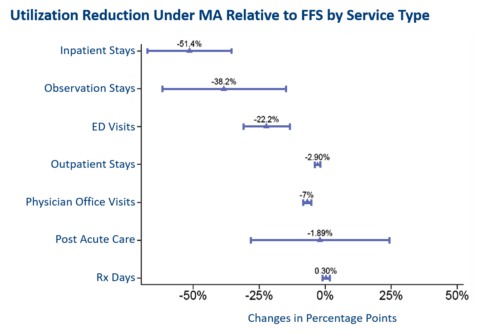
Our researchers found that a substantial gap in utilization emerged between MA and FFS immediately after entering Medicare. In comparison to FFS, MA enrollees have more than 50% fewer hospitalizations and 22% fewer emergency department (ED) visits. At the same time, we found that MA has comparable amounts of primary and routine care visits and similar prescription drug utilization.
As seen in Figure 1, at Medicare enrollment the cost difference between MA and FFS is about $200 per quarter, but as the member nears age 67, the cost difference grows to over $600 per quarter. FFS costs continue to increase during the two years following enrollment at age 65, while costs in MA stabilize and actually start to decline. This is consistent with the decrease in utilization being driven by care management and preventive care—both of which are much more prevalent in MA.

Another finding was that utilization was substantially higher under FFS than for the same patients under commercial insurance. We see a sharp 20% increase in utilization immediately after members transition from commercial insurance to FFS. This increase spikes to 35% higher costs within the two years after switching to FFS. While patients do tend to use more healthcare as they get older, this spike likely does not reflect these patients suddenly getting sicker right after turning 65. It is also unlikely that this spike is due to a strategic delay in care because that would present as more of a transient spike rather than this sustained growth seen in Figure 1.
We also evaluated how much MA reduces service-specific utilization following Medicare enrollment (Figure 3). We found MA results in substantially lower acute care utilization including 51% fewer hospitalizations and 22% fewer ED visits.
Medicare efficiency findings
This research finds powerful new evidence that MA reduces utilization and improves overall efficiency relative to FFS. MA expenditures are 12% lower than FFS. These savings are concentrated in costly and preventable services like inpatient stays and emergency visits, suggesting MA reduces wasteful care without reducing access to high-value primary care. If MA was actually reducing access to high-value care, we would expect this to produce an offsetting increase in ED or observation stay utilization (through increased complications) rather than the decrease that we actually observed.
The results demonstrate that MA is enhancing efficiency from a cost perspective by lowering costs for Medicare and potentially benefitting patients in terms of health outcomes. On top of that, we found that the reduction in utilization increases over time. There may be even more longer-term benefits of MA due to the delayed impacts of care coordination and receipt of preventive services that grow over time. The benefits of MA may be even greater if we were to look over a longer period of time.
FFS appears to be a glaring outlier relative to other common forms of coverage, in terms of overall utilization and especially its reliance on costly inpatient and ED care. FFS lacks valuable features common in most private health plans such as active patient management and care coordination. While there have been efforts to introduce more cost and quality incentives into FFS, such as Accountable Care Organizations (ACOs), our findings suggest that these efforts did not go far enough and that additional reforms are needed.
Unique research methods powered by Inovalon
These results were possible by our ability to track the two groups over time, starting two years before Medicare enrollment, and then following their utilization two years after Medicare enrollment. Inovalon’s claims data include longitudinal coverage on over 30% of all privately insured lives and 100% of public Medicare lives at any given point in time1, making it the largest longitudinal claims dataset in the U.S., and surpassing the data assets of even the federal government and Centers for Medicare & Medicaid Services (CMS). This makes our data assets the closest equivalent to a nationwide all-payer claims database in existence, positioning Inovalon as uniquely qualified to conduct this research in close collaboration with Harvard Medical School.
This unique database has given Inovalon and Harvard researchers unprecedented visibility into the Medicare and U.S. healthcare system, to support this groundbreaking research.
Discover more about the powerful data findings
By leveraging Inovalon’s all-encompassing dataset, this study overcomes challenges and limitations that have hindered past studies. The results of this study provide a better understanding of the core differences in healthcare utilization and cost efficiency between MA and FFS that are attributable to the programs themselves and not due to differences in who enrolls in them.
This research will inform health plans on how they can target their offerings to better meet the needs of their core customer base and will inform policymakers on how they can potentially improve these government-funded programs to increase efficiency and quality across the healthcare continuum.
Stay tuned for the third part of this research series to learn how MA and FFS differ in terms of quality care and health equity outcomes.
Read more details about the differences in Medicare utilization and efficiency across MA and FFS in our whitepaper.
Sources:
1Inovalon internal reporting. August 2023
Inovalon and design®, Inovalon®, and the Inovalon ONE® Platform are trademarks of Inovalon, Inc.


