
AI Isn’t Taking Your Job – It’s Changing It
Written by
Inovalon
Quick Navigation
The rise of AI in healthcare has sparked a debate: Will it replace skilled professionals or enable us to work smarter?
While some fear job displacement, others are more optimistic. Neither perspective is 100% true. As beneficial as AI has the potential to be, it must also remain a tool, not a replacement for the human expertise that is invaluable in healthcare. Striking the right balance varies across roles and care settings but is necessary to further professional development and remain competitive.
This blog explores the common concerns regarding AI’s influence in healthcare careers, and how a “human in the loop” approach of technology and skilled expertise working together can significantly improve the entire industry.
Common concerns about AI replacing healthcare jobs
For many, AI went from an emerging technology to an overnight sensation. It isn’t just a trend anymore – it’s here to stay. However, mixed feelings remain.
“AI is taking my job”
Healthcare needs humans at the helm of every action and decision, from verifying a patient’s eligibility to making a diagnosis decision or a treatment recommendation.
AI can support these processes, but it cannot replace healthcare professionals. With the importance of data protection, regulatory requirements, and the need for informed, compassionate decision-making, AI must serve as a copilot, enhancing efficiency while keeping humans in control.
“AI is making my day more complicated; it’s not easy to use”
Healthcare is in a constant state of change. For many dedicated (and exhausted) professionals, keeping up with regulations, reporting requirements, and unpredictable patient behavior can feel overwhelming. Add M&A activity and the increased use of all technology, not just AI, to the mix, and change is happening every day in some form.
AI is a change worth leaning into. While seemingly daunting to use at first, there is a world of opportunity awaiting. AI can save you time, allowing you to focus on what really matters versus repetitive, manual work. It can even keep up with healthcare changes by using models that are built with healthcare-specific requirements – and the latest rules – in mind.
“My job is specialized – I have years of training; I don’t need AI”
For those who consider their expertise too niche to benefit from AI, healthcare-specific models show that it’s possible for even the most well-trained physicians or skilled researchers to find value in this technology.
For example, healthcare models trained on accurate, clean data can help identify cancer or offer care plan recommendations. While the decision to confirm a presence of cancer or to offer treatment options is ultimately up to the skilled individual, the support of AI to better understand a patient’s condition helps guide the physician to the most important details in front of them.
Using AI in healthcare careers: Technology and humans working together
AI enables faster, more informed clinical decisions – ensuring providers have a comprehensive view of the patient when it matters most. From verifying insurance coverage and enhancing clinical coding accuracy to analyzing patient populations and streamlining clinical trial recruitment, AI empowers healthcare professionals to work more efficiently and with greater precision.
Speeding up manual work
Too much of healthcare is still operating manually. With AI, there’s a better way to streamline workflows, reduce errors, and free up time for what truly matters – patient care.
These are just a few of the time-saving improvements available with AI.
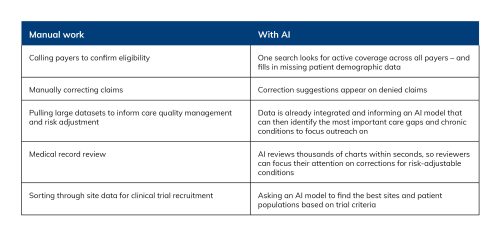
These AI-powered improvements do more than save time – they are changing how healthcare works for the better.
Shifting focus to more meaningful work
AI may not be replacing human work, but it is making the work we do more meaningful. With a profound impact on manual tasks and significant increases in efficiency, healthcare professionals are left with more time in their day to focus on what really matters.
For a physician, this can mean spending precious extra time with each patient or seeing more patients in their day. For a pharmacist, less manual work creates more time to educate patients on their care plan and encourage them to keep up with their medication adherence.
At a health plan, a quality manager can now spend more time making strategic decisions that improve quality performance – both for the plan’s ratings and for the care outcomes of the members they serve. In a life sciences organization, AI can drive more meaningful insights, faster – helping teams navigate the hurdles of clinical trials, market research, post-market surveillance, and more.
AI is replacing the manual work that has long held back healthcare, giving humans the room to create more meaningful impact with the specialized skills AI can’t do.
The skills that make us human – and AI can’t do
Everyone has a healthcare need at some point in their life, and at times, it can be scary. When your loved one is suddenly in the emergency room, when you’re holding your breath for a good outcome from a diagnosis test, when you’re preparing for a major surgery – AI can’t comfort you, but physicians and nurses can.
Empathy, compassion, and human connection cannot be automated. Bedside manner isn’t something an algorithm can replicate, and no bot can replace the reassurance of a skilled clinician.
As we continue to discover the value of AI and find new ways to go further, faster, we must also maintain all the pieces of healthcare that require a thoughtful human approach.
Unique human traits, combined with a deep understanding of AI tools, create a competitive advantage and ensure professionals remain invaluable in advancing patient care and outcomes. The question is not whether AI will replace your role, but how you will adapt to it to achieve more in your days and elevate the value of your role.
Inovalon and design®, Inovalon®, and the Inovalon ONE® Platform are trademarks of Inovalon, Inc.


