
Open Claims vs. Closed Claims: Choosing a Research Foundation
Tasha Boshears
Senior Director, Commercial Analytics
Quick Navigation
Open claims and closed claims come from the same healthcare event, but separate at adjudication, where a health plan processes a claim and decides what it will pay.
That mechanic matters more than you may think when you need to accurately answer the question in front of you. A research question about what happens to patients over time and a commercial question about what is happening in a territory this month are generally better served by one claim type than the other.
In this blog, we’ll cover where the two claim types separate, what each one gives you, the coverage gaps most comparisons leave out, and how to match the right source to your question.
Where open claims and closed claims split
A provider submits a claim through a clearinghouse. The clearinghouse routes it to the payer. The payer processes it and returns a remittance.
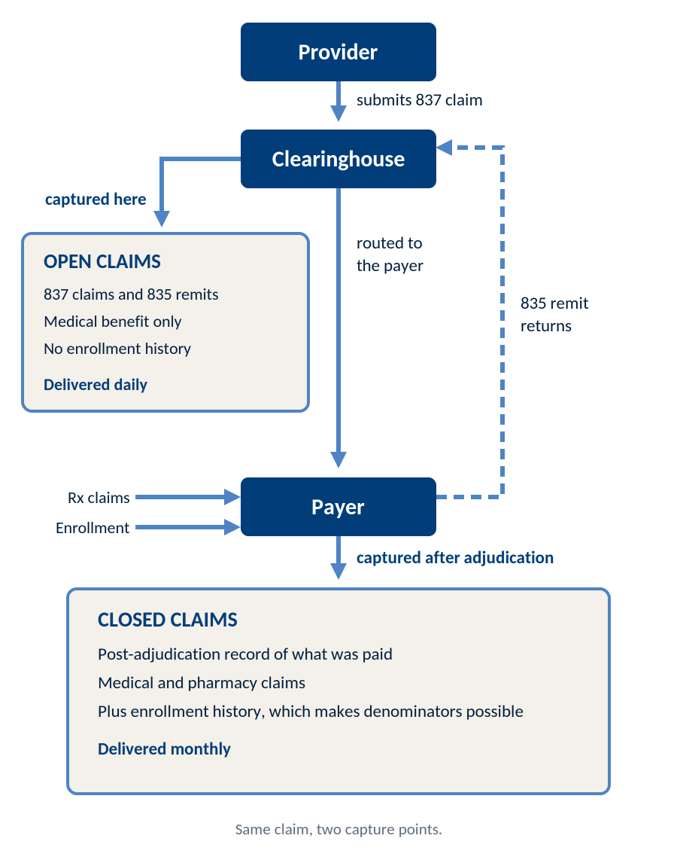
Open medical claims are generated by clearinghouses: the provider submits the 837 claim to the clearinghouse. The clearinghouse checks, formats, and routes the claim for submission to a payer. The payer then responds to the claim with an 835 remittance record, but that response can go back through the clearinghouse, directly to a provider, or through a different clearinghouse altogether.
Closed claims are generated by the payer: they are the final post-adjudication record, and include the member’s enrollment history in the plan. They hold all the medical and pharmacy claim submissions for a member during their insured segment.
It is the same claim, captured at two different points in the same process. Where the capture happens determines both what information it holds and how quickly it arrives.
What open claims and closed claims each give you
Open claims are provider-anchored and current
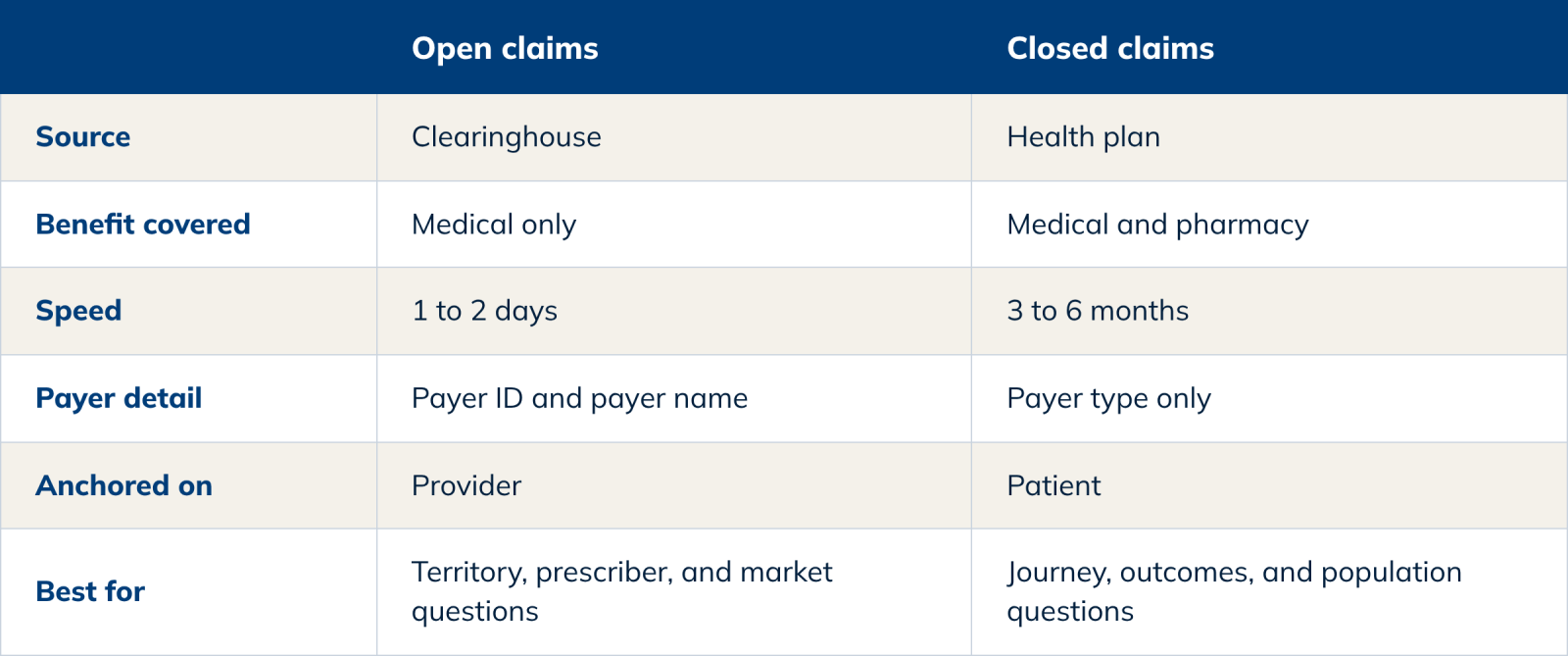
If a provider routes claims through a contributing clearinghouse, that provider’s routed volume is visible in full, and it is visible fast. Claims can appear within days of submission. That recency is why open claims anchor commercial work, where the clinical window a team is trying to influence closes in weeks:
- Territory planning
- Prescriber identification
- Payer insights
- Site-of-care trends
The trade-off is at the patient level. Care delivered by providers who route elsewhere is not captured, pharmacy data has to be linked through another dataset, and the claim is a pre-adjudication view, meaning information that later changes could be acted on as though it were final.
Closed claims are patient-anchored and settled
Because every claim record for an insured member routes to the associated payer, the closed claims dataset covers a patient’s care across all settings for the duration of their insurance enrollment. That includes both their medical and pharmacy claims and their associated coverage history. Within a patient’s enrollment period and covered benefit, absence of a claim is meaningful evidence that the event did not occur. That makes denominators possible and supports:
- Observational research
- Health economics
- Burden of illness
- Treatment patterns
- Disease prevalence and incidence
The trade-off is timing and enrollment. The record only exists once the plan has processed it, so closed claims carry a lag of roughly 3 to 6 months, against 1 to 2 days for open claims. And people change plans, which means a patient who leaves a contributing plan leaves the dataset.
That second constraint scales with the breadth of the source. A dataset drawing from many plans across commercial, Medicare Advantage, and Medicaid holds more of a patient’s coverage history than one concentrated in a single payer type. No dataset holds every plan. A nationally representative one holds patients for longer.
What gets missed in most open vs. closed claims comparisons
Both datasets have a gap that rarely appears in vendor comparisons, and they are not the same gap.
Open claims can miss the full patient story
Not every claim reaches licensable open data. Some clearinghouses do not release their transactions for research use. Large health systems with their own EDI teams sometimes build direct connections to major payers, and claims moving through those connections do not pass a clearinghouse either. And in regional markets where the health plan and the provider are the same organization, care for that plan’s own members never becomes a third-party claim at all. These effects are not random. They are geographically and institutionally patterned, which means open-only cohorts can carry regional bias and miss patient and provider information the study depends on.
Closed claims can miss the plan
Closed claims identify coverage by payer type (commercial, Medicare Advantage, or Medicaid) rather than by payer name. It is strong for population-level studies, where plan type is enough to support subgroups. It is not enough for questions that need a named plan: contracting analysis, formulary position, plan-level access barriers, or where a therapy is sitting well or poorly by carrier. Open claims carry payer ID and payer name at the claim level, which is why teams with a payer mix question often start there even when the rest of the study is patient-anchored.
Neither gap is a defect. Each one is a consequence of how the data was captured. The question is where the gap sits on the variable your study depends on.
Safety isn’t just about compliance – it’s about culture. A true culture of safety involves continuous learning, accountability, and engagement across all levels.
Matching open or closed claims to your question
Anchor on closed claims when the question is about:
- The patient journey and treatment patterns across care settings
- Patient outcomes, cost, and utilization, including pharmacy use and costs
- Population-level reporting including incidence and prevalence rates
Anchor on open claims when the question is about:
- A provider, account, or territory, for a full view of a contributing provider’s activity
- What changed this month, for visibility within days of submission
- Payer mix by named plan, for payer ID and payer name at the claim level
Consider linking both when the question is about:
- Long-term chronic conditions where a patient journey can span the switch from commercial to Medicare coverage
- Full provider coverage, including providers who do not route through a contributing clearinghouse
A practical shortcut: if your cohort definition starts with a patient, start with closed claims. If it starts with a physician, an account, or a territory, start with open.
When the answer is both open and closed claims
Many study designs need each dataset for a different job rather than one merged foundation.
A launch analytics team may size the treated population in closed claims, then track weekly prescriber adoption in open claims. An epidemiology team may build the cohort in closed claims for the enrollment denominator, then use open claims to observe activity outside the enrollment window.
Provider identification runs the other direction. Open claims show a contributing provider’s routed volume in full, but a provider who does not route through a contributing clearinghouse does not appear at all. Closed claims capture every claim submitted to a contributing plan, so the treating provider is on the record regardless of how the claim was routed. In rare disease, where the treating population is small and geographically scattered, that difference decides whether a target list is usable.
Coverage transitions in chronic conditions are one place where open claims fill a gap in the closed claims record. A chronic disease cohort followed across a decade will see part of itself turn 65. Most of that group stays visible in closed claims: 55% of eligible Medicare beneficiaries were enrolled in Medicare Advantage in 2026, and Medicare Advantage is administered by health plans, which is where closed claims are sourced. The rest move into traditional Medicare, which is paid by the federal government rather than by a commercial plan and therefore sits outside that channel. Those encounters have not disappeared. Many of the claims still route through a clearinghouse on the way to the payer, which is the point where open data captures them. For a cohort that ages, open claims are what keep the tail of the timeline from going dark.
Putting open and closed claims to work
The choice between open claims and closed claims is a study design decision more than a procurement one. Each dataset was captured at a point in the claim process that makes it strong on some questions and blind on others, and no amount of volume changes that.
That makes a specific question more useful than a general requirement when you start a data conversation. Ask what a dataset was built to answer, and ask what it will not see. The second question is the one that changes study designs.
Explore Inovalon’s Real-World Data™ to see how open and closed claims can support your research.
Frequently asked questions about open claims vs. closed claims
Is closed claims data more accurate than open claims data?
Neither is more accurate. Open claims record what was submitted. Closed claims record what the plan processed and paid. They answer different questions, and accuracy is a property of the question rather than the dataset.
How much faster is open claims data?
Open claims can be visible 1 to 2 days after submission because they are captured before processing. Closed claims are available after the plan processes the claim and delivers the file, typically 3 to 6 months.
Can open claims and closed claims be linked at the patient level?
Yes, through privacy-preserving tokenization. Both datasets carry a de-identified patient token, which allows the same individual to be followed across sources without exposing identity. The same approach supports linking claims to structured EHR data and clinical notes.
Which one do I need for a payer submission?
Most economic dossiers depend on closed claims, because cost, utilization, and enrollment-based denominators come from the plan record. Open claims more often play a supporting role for market context. If you are working through a specific submission and want to know which source fits, get in touch.
Inovalon and design® and Inovalon® are trademarks of Inovalon, Inc.


