
Exploratory Analysis of Real-World Enrollment Patterns Among Dialysis-Dependent Commercial Plan Members With End Stage Renal Disease
Summary
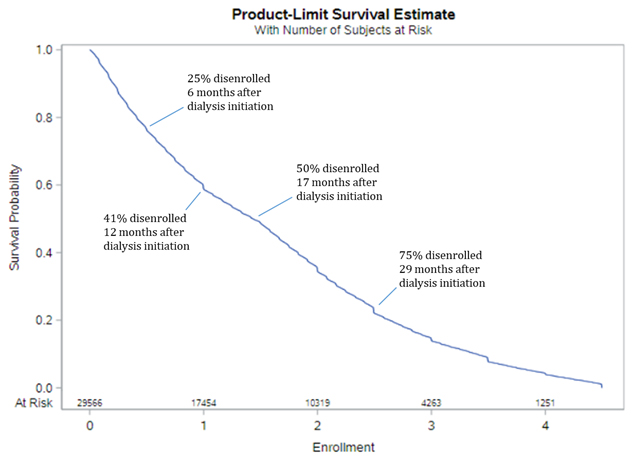
Inovalon conducted an exploratory analysis of real-world enrollment patterns among dialysis-dependent patients with end-stage renal disease (ESRD) enrolled in commercial health plans. Among plan members who initiated dialysis between 2019 and 2021, 41% disenrolled from their commercial plan within a year of initiating dialysis. More than 75% disenrolled by 30 months after dialysis initiation, which marks the end of the dialysis coordination of benefits period between the commercial plan and Medicare. These findings indicate any extension of the mandatory 3-month waiting period before Medicare eligibility may leave dialysis-dependent individuals without a reliable source of healthcare coverage.
Background and Research Objective
ESRD occurs when kidney function declines to the level where the patient requires ongoing dialysis care or a kidney transplant to survive. In 2021, more than 808,000 people in the U.S. were diagnosed with ESRD.1 There are substantial disparities in the development of ESRD; Black, Hispanic, Native American, and Asian Americans are significantly more likely than white Americans to develop ESRD.1
ESRD is managed with dialysis, a treatment where extra fluids and waste products in the blood are removed. Over 68% of patients with ESRD receive maintenance dialysis, which typically requires three in-facility sessions per week or home care.1 While most patients with ESRD receive in-center hemodialysis, some patients may receive home hemodialysis or peritoneal dialysis.1
While a diagnosis of ESRD is one of the few ways that a patient may become eligible for Medicare benefits under the age of 65, over 40% of patients newly diagnosed with ESRD are not covered by Medicare.1,2 Many of these dialysis patients initially receive coverage from their existing commercial health plans.1 Commercial members diagnosed with ESRD are subject to a 3-month waiting period for supplemental Medicare coverage following dialysis initiation.2 Following this waiting period, Medicare can become a secondary payer for dialysis if the beneficiary is only eligible for Medicare due to an ESRD diagnosis, the beneficiary is already covered by a group health plan, or the beneficiary is within an initial 30-month coordination period that begins when they could have enrolled in Medicare. Following this 30-month coordination period, Medicare becomes the primary payer.2
ESRD and maintenance dialysis can place substantial burdens on patients, including prohibitively high care costs, poorer quality of life, and potential loss of productivity and income. Data from the National Institute of Diabetes and Digestive and Kidney Diseases (NIDDK) and previous studies have shown that employment rates significantly decline after the initiation of dialysis.1,3 These burdens may result in commercial members needing to find an alternate primary health plan coverage before the end of the 30-month coordination period with Medicare (i.e., the safety net). This analysis aimed to explore enrollment patterns among a sample of commercial beneficiaries with ESRD that initiate dialysis.
Findings
The exploratory analysis evaluated enrollment trends among a sample of 29,566 commercial plan members with ESRD that initiated dialysis between January 1, 2019, and December 31, 2021. Within a year of initiating dialysis, 41% of dialysis-dependent beneficiaries were disenrolled from their commercial plan and half were disenrolled within 17 months of dialysis initiation (see Figure 1). By 29 months after dialysis initiation, 75% of commercial members were disenrolled, just one month prior to the end of Medicare’s 30-month coordination of benefits period.
Figure 1. Kaplan-Meier showing time from dialysis initiation to commercial plan disenrollment (in years)
Enrollment trends were also evaluated on a quarterly basis among 34,124 commercial plan enrollees who initiated dialysis between January 1, 2019, and June 30, 2022. Across all evaluated quarters, 60-82% of dialysis-dependent enrollees remained enrolled in their original commercial plan at 6 months after dialysis initiation (see Table 1). Continued enrollment drops after dialysis initiation were seen at 12 months (47-67% still enrolled), and most enrollees had disenrolled by 24 months (31-46% still enrolled). By 30 months post-dialysis initiation, 26-40% remained enrolled in their original commercial plan.
Table 1. Commercial Plan Members that Remain Enrolled after Initiating Dialysis, by Calendar Quarter

Quarterly continued plan enrollment percentages are indicated with a green circle if they are >80%, a yellow triangle if they are 50-80%, and a red diamond if they are <50%.
Potential Policy Implications
A substantial number of ESRD patients receiving dialysis are enrolled in commercial plans before qualifying for coverage under the Medicare ESRD benefit.1 While the coordination of benefits period before primary Medicare coverage lasts 33 months after dialysis initiation (3 month waiting period followed by the 30 month coordination period), 41.3% of commercial beneficiaries were no longer enrolled in their original plan 12 months after starting dialysis. Additionally, only 26-40% of commercial beneficiaries were still enrolled 30 months after starting dialysis.
Although the reasons for plan disenrollment were not captured in the data, this is a clear area to explore in follow-on research:
- The time and physical demands required for dialysis often impacts employment.4 For example, NIDDK data show an estimated 34% decrease in full-time employment after dialysis initiation, with the greatest decreases among individuals ages 35-44.1 Decreased employment affects continuous enrollment in commercial plans and may cause commercial members to utilize the Medicare ESRD benefit seen in this exploratory analysis before the end of the coordination of benefits period.
- It is possible that for reasons unrelated to their ability to remain employed due to dialysis, that the member transitioned to different coverage (e.g., Medicaid, COBRA, or a spouse’s benefit plan). Of note, the Medicare Secondary Payer Act prohibits commercial plans from actively considering ESRD as a basis of coverage.
- Commercial members with incident ESRD can age into Medicare. However, NIDDK data show that only 13% of Americans were ages 60-64 when first diagnosed with ESRD in 2021, demonstrating that age-based eligibility for Medicare is likely not the primary driver for commercial plan disenrollment.1
- Though some of the disenrollment is likely due to mortality, published 1-year mortality rates for patients with ESRD receiving dialysis is around 15-20%,5 which does not fully account for the disenrollment rates identified in our exploratory study sample.
ESRD care and dialysis can result in high care costs, particularly in the commercial sector, where research has indicated that some commercial plans may be paying more than six times the rate of Medicare for the same dialysis services.7,8 These findings indicate that any policy that creates additional barriers to accessing the Medicare ESRD safety net, such as extension of the mandatory waiting period before Medicare eligibility, may leave patients initiating dialysis without a reliable source of coverage.
Methodology
This exploratory, retrospective claims analysis used the Inovalon MORE2 Registry®, which is a statistically de-identified, real-world dataset comprised of medical and pharmacy claims and enrollment data from health plans across the U.S. We identified a convenience sample of health plan members with commercial insurance that were diagnosed with ESRD or dialysis-dependence (ICD-10-Dx N18.6 or Z99.2) and first received in-facility hemodialysis between January 1, 2019, and December 31, 2022. Dialysis encounters were identified from medical claims with CPT 90999 and revenue code 821. Duration of enrollment was determined from member enrollment records. Mortality and reason for disenrollment could not be ascertained from the de-identified data. These exploratory results are descriptive in nature; consequently, additional research is warranted to evaluate member-level and plan-level drivers of disenrollment, as well as future coverage for members that leave their plans. The study window also overlaps with the COVID-19 public health emergency, which may contribute to quarterly fluctuations in enrollment.
Inovalon is a leading provider of cloud-based software solutions empowering data-driven healthcare. The Inovalon ONE® Platform brings together national-scale connectivity, real-time primary source data access, and advanced analytics into a sophisticated cloud-based platform empowering improved outcomes and economics across the healthcare ecosystem. Inovalon’s analytics and capabilities are used by more than 20,000 customers and are informed by the primary source data of more than 79 billion medical events across one million physicians, 654,000 clinical settings, and 375 million unique patients. For more information, visit www.inovalon.com.
REFERENCES
- United States Renal Data System. 2023 USRDS Annual Data Report: Epidemiology of kidney disease in the United States. , 2023. https://adr.usrds.org/2023
- CMS. Medicare Secondary Payer ESRD Introduction. https://www.cms.gov/medicare/coordination-of-benefits-and-recovery/coordination-of-benefits-and-recovery-overview/medicare-secondary-payer/downloads/msp-end-stage-renal-disease-esrd.pdf
- Hallab A, Wish JB. Employment among Patients on Dialysis: An Unfulfilled Promise. Clin J Am Soc Nephrol. Feb 7 2018;13(2):203-204. doi:10.2215/CJN.13491217
- Kirkeskov L, Carlsen RK, Lund T, Buus NH. Employment of patients with kidney failure treated with dialysis or kidney transplantation-a systematic review and meta-analysis. BMC Nephrol. Oct 22 2021;22(1):348. doi:10.1186/s12882-021-02552-2
- UCSF. The Kidney Project. https://pharm.ucsf.edu/kidney/need/statistics
- Health Insurance Coverage in the United States: 2022 (U.S. Government Publishing Office) P60-281 (2023).
- Boumil MM, Curfman GD. Reining in Costs of Kidney Dialysis: US Supreme Court Offers Hope to End Predatory Pricing. Clin Ther. Mar 2023;45(3):264-271. doi:10.1016/j.clinthera.2022.12.002
- League RJ, Eliason P, McDevitt RC, Roberts JW, Wong H. Variability in Prices Paid for Hemodialysis by Employer-Sponsored Insurance in the US From 2012 to 2019. JAMA Netw Open. Feb 1 2022;5(2):e220562. doi:10.1001/jamanetworkopen.2022.0562


