
WHITE PAPER
Exploring AI’s Role in Revenue Cycle Management:
A Data-Driven Study of Adoption and Sentiment
Executive Summary
An Inovalon research study conducted among over 400 healthcare leaders and professionals revealed a variety of perspectives on using artificial intelligence (AI) in the healthcare revenue cycle.
Executives and managers were generally optimistic about AI. They could easily articulate use cases for AI within their revenue cycles, most frequently enabling efficiency while preventing and managing denials.
Executives and managers were also thoughtful about the conditions/requirements under which they would engage AI-enabled revenue cycle solutions. These requirements include the need for rigorous testing and training of the AI, and the need to have their experienced revenue cycle team driving process and decisions, with AI playing a critical, yet subordinate role.
Key takeaways:
- Significant optimism is the prevailing sentiment toward AI’s potential in healthcare revenue cycle management (RCM).
- Providers recognize the value AI can bring to the healthcare revenue cycle – particularly to areas like denials prevention and management.
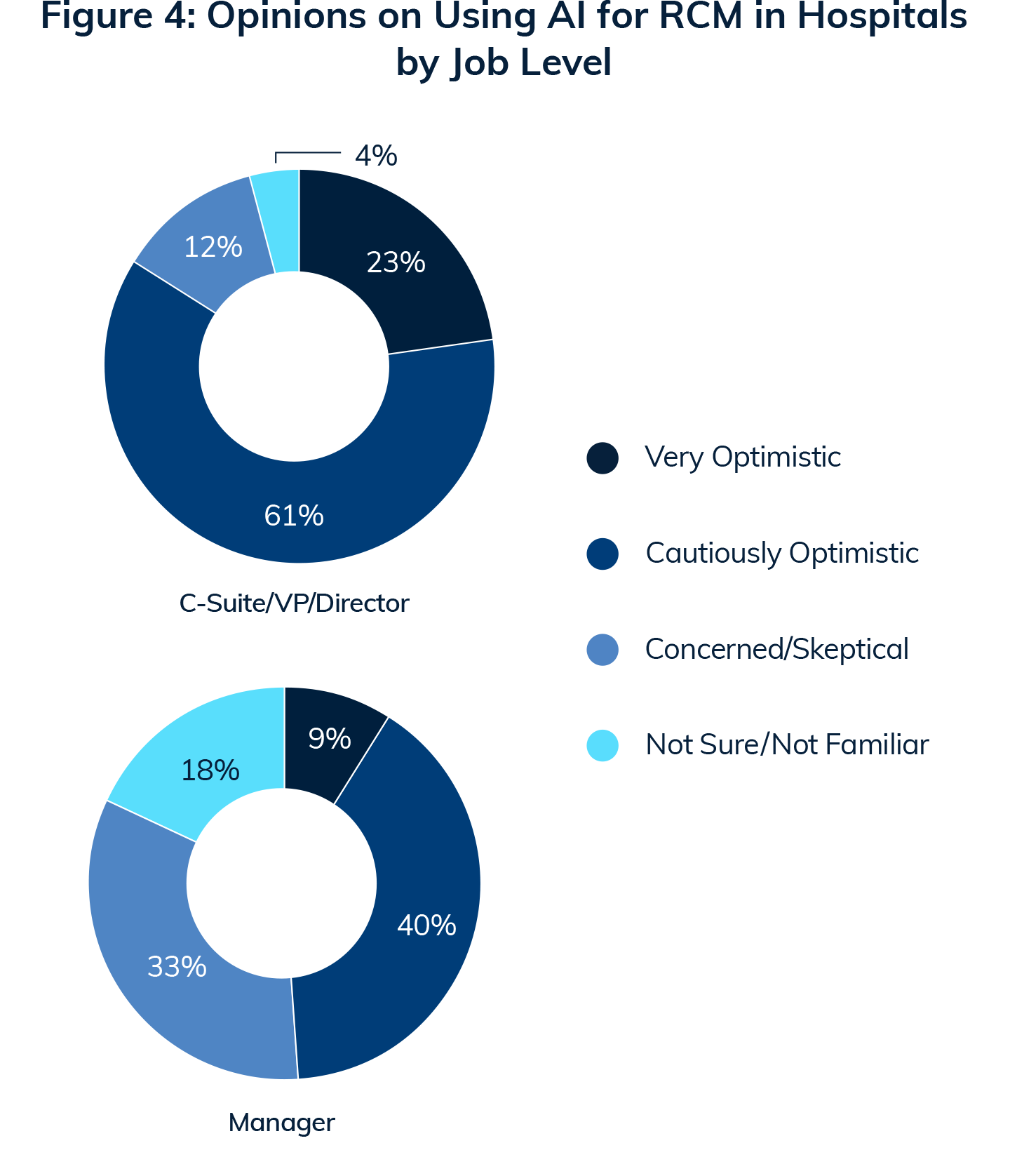
- In hospitals, executive leaders are especially optimistic about the promise of AI.
”I am hopeful it can reduce cost and improve efficiency in the revenue cycle. If any time can be saved in claims that would help immensely.”
”AI may be able to handle claim scrubbing, denials management ‘automatically.’”
Introduction
Background
Artificial Intelligence (AI) is an innovation which could have major positive impact for healthcare. Although AI is in relatively early stages of adoption, its potential for application across many aspects of clinical and operational workflows is becoming increasingly apparent.
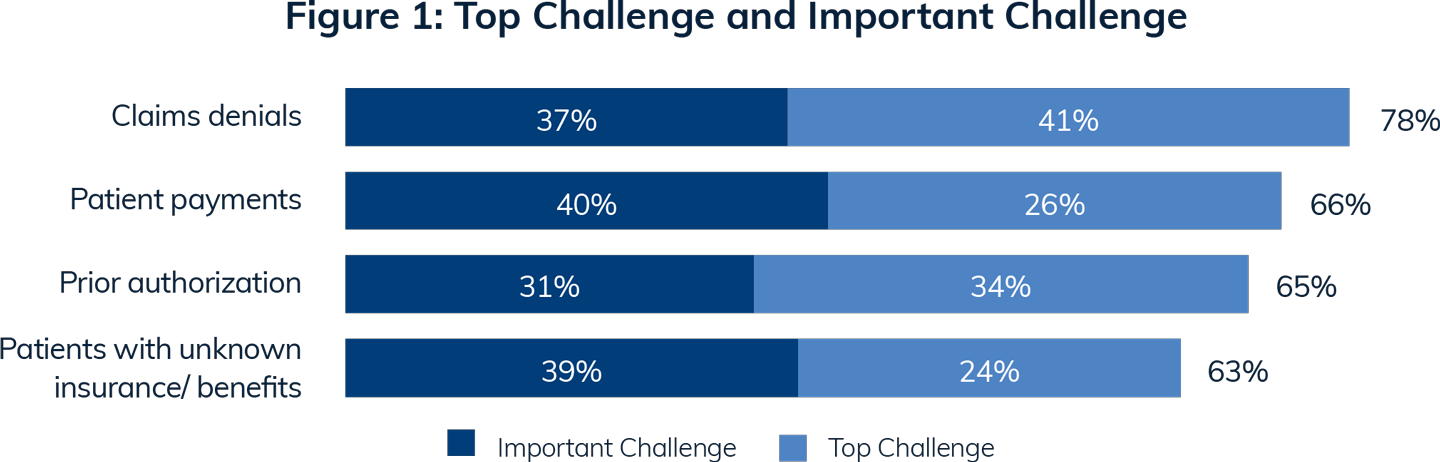
At the same time, financial and revenue cycle leaders are prioritizing greater automation and unification of revenue cycle, while focusing on important revenue challenges such as denials, patient payment, and the complexity of locating accurate patient coverage and benefits [see Figure 1].
In the context of revenue performance improvement priorities, and AI’s potential promise, Inovalon initiated a research study to explore perspectives on the use of AI in the revenue cycle.
About This Research
To form a holistic and representative view of provider perspectives, a diverse group of over 400 revenue cycle and financial executives and managers were asked for their perspectives on using AI in revenue cycle. These professionals weighed in from across the healthcare landscape, including health systems, hospitals, physician groups, and post-acute care providers.
Participants had excellent visibility across their organizations’ revenue cycle, end-to-end. Participants were asked a series of questions designed to gauge their attitudes, concerns, and expectations regarding AI in RCM. The survey explored topics such as perceived benefits and concerns of AI, and areas where AI might improve revenue cycle management.
Challenges Ranked as Top and Important
Sizable majorities of respondents agreed that the following issues were significant for their organizations.
Revenue cycle leaders articulating their priorities for RCM
“To use the cycle advantageously to be a profit maximizer and enhance cash flows.”
“To eliminate manual intervention and make electronic as many workflows as possible.”
“To be able to utilize [revenue cycle] in a way that maximizes our ability to accurately forecast our financial outcomes.”
“Ensuring reduced denials, enhancing customer experience through advanced patient portal, AI assisted coding, CDI.”
“Collecting every dollar that we are due. Collecting 100% of recorded net patient revenue.”

Challenges Ranked as Top and Important
Sizable majorities of respondents agreed that the following issues were significant for their organizations.
Key Survey Results
Overall AI Sentiment
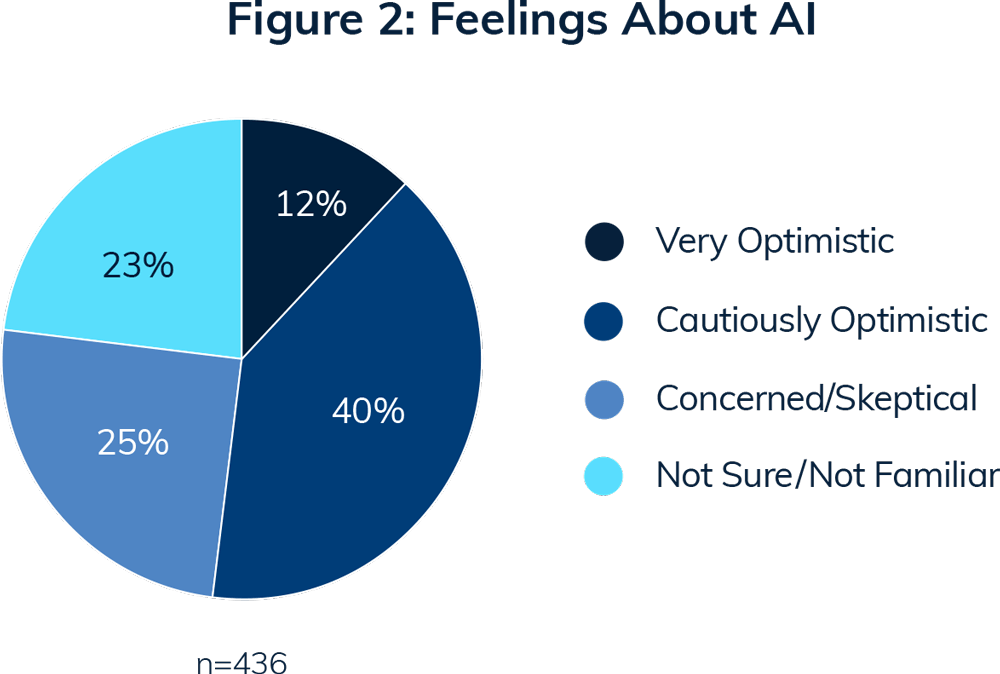
The insights gleaned from this research show that overall, the sentiment toward AI is positive. Nevertheless, many of those who were optimistic expressed caution, an indication that they would likely not take the plunge without appropriate guardrails to ensure the success of an AI-enabled revenue cycle. Their common desire is for providers to remain in the driver’s seat when employing AI, with AI assisting in enhancing the patient experience and optimizing outcomes.
A Positive Outlook, But With Sizable Hesitation and Unfamiliarity
”AI is so new, I’m not sure how to answer this. But, I know it is coming and I believe it will be helpful.”
Reasons for Optimism

”If AI could flag potential denials ahead of submission of claim, that would be tremendously helpful.”
”Identify trends in denials that we may miss. Automatically create appeals when setting up with parameters.”
Promising Applications for AI
Participants were asked to specifically articulate areas where their organization’s revenue cycle could be improved using thoughtful application of AI. Applied AI was expected to drive additional efficiency and process optimization in these broad areas.
- Predict denials, flag potential denials prior to submission, appeal mass denials, or generate appeal letters to overturn denials
- Alerts to prevent friction in the revenue cycle or surface overlooked items
- Provision of revenue cycle insights
- AI-based pre-reviews to speed up conventional review processes
- Cost control via selective automation of expensive human-oriented tasks
- Accelerate communications for patient collections (replies to patient inquiries)
- Diagnosing and solving for problems within the overall revenue cycle
- Risk assessment
AI-Driven Solutions for RCM Staff Shortages
Participants also provided examples of how AI was expected to mitigate any staff shortages in revenue cycle teams, allowing staff to work at the top of certification, and freeing staff to be their best, most personable selves when interacting with patients and families.
- By reducing manual process, enabling staff to maximize their certifications
- By standing proxy for staff member experience during high turnover periods
- Potentially reducing level of training required
Readiness to Engage AI: Leaders vs. Others
Those closest to the top, with the greatest visibility into how AI can enable revenue cycle teams to achieve more positive financial outcomes, are most excited about AI. It will be up to these leaders to engage revenue cycle teams in identifying specific opportunities.
By the data [see Figure 4] – Here’s how opinions differ across various job roles within hospitals and health systems:
- Senior leaders: Express high optimism about AI’s strategic benefits, emphasizing its potential to streamline tasks and reduce staff workload.
- Managers: Display more caution, raising concerns about AI’s reliability and accuracy, with many sharing a lack of familiarity with AI.
Senior leader opinions:
“I am hopeful it can reduce cost and improve efficiency in the revenue cycle. If any time can be saved in claims that would help.”
“Rule-based logic can identify problems of key indicators much earlier in the process.”

Manager opinions:
“I would require in-depth testing of the functionality of any AI program before I’d be willing to entrust our claims to the process.”
“Unsure of the reliability of AI in our application. To my understanding, AI utilizes predictive algorithms based previous ‘scenarios’.”

Conditions/Requirements for Engaging AI
As with notable previous innovations (e.g., personal computers or electronic medical records), in early phases of adoption, uncertainty and caution are commonly associated with initial engagement, and are indicative of thoughtful consideration.
As participants considered AI, and reasons they were cautious, they articulated requirements for the AI technology itself [see Figure 5]: algorithms must be thoroughly trained and updated, rigorously tested, and thoughtfully implemented so as to be both reliable and accurate.
Additionally, research participants stipulated that human expertise and judgment should not be subordinated or bypassed as AI is implemented in the revenue cycle. In short – the revenue cycle team remains in the driver’s seat.
”I do not believe that AI is ‘educated’ enough or has enough knowledge—yet —to make good and correct determinations.”

”Identifying missed charges/workflow improvements and efficiencies assist the team to work easier or soft denials.”
”I am hopeful it can reduce cost and improve efficiency in the revenue cycle. If any time can be saved in claims that would help.”
”Technology enhancements will allow us to fully optimize the utilization of our current staff for more personable situations with patients."
Summary: Seizing Opportunities with AI
This Inovalon research highlights a significant opportunity that AI will significantly improve revenue cycle performance. AI’s strengths and capabilities align with priorities articulated by hospital leaders, as well as executives and managers in other care settings: achieving greater revenue cycle efficiency and accuracy through automation. Leaders’ understanding of the parameters/conditions of engagement with AI (rigorous testing, subordination to human decision-making, etc.), coupled with their optimism and excitement, suggest that AI adoption will likely accelerate from this point forward, with positive outcomes for healthcare organizations.
Improve Your Revenue Cycle Performance
Check out our free RCM ROI calculator, or schedule time with a revenue cycle expert today.


